Sooner or later someone tells a small business it is "too focused on short-term performance" and needs to invest in brand. Someone else tells it that brand is what big companies spend money on when they've stopped counting, and every pound should go somewhere it can be traced to a sale.
Both people are describing a real thing. Neither is describing your business.
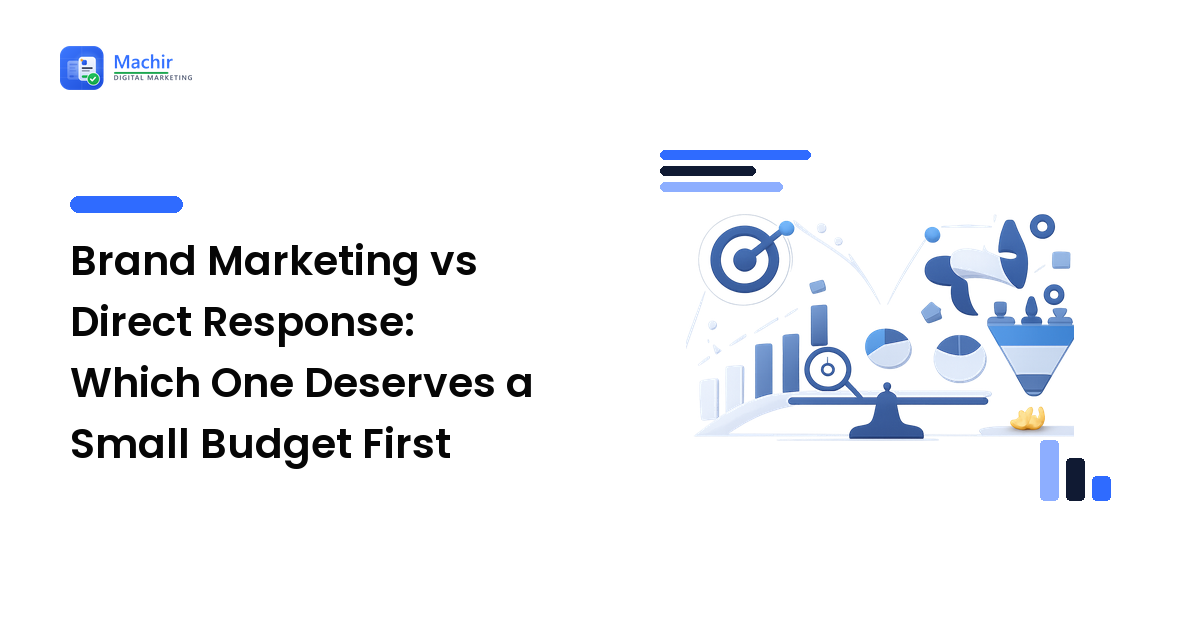
The takeaway up front: these two are not rival philosophies, they are two different jobs — creating demand and capturing it — and which one to fund first is settled by whether demand for what you sell already exists. If people are already looking for your category, capture is cheap and creation is a luxury. If nobody is looking, capture has a hard ceiling and no amount of budget will lift it.
What each one actually is
The labels get muddled, so it's worth being concrete.
Direct response asks for an action now and measures whether it got one. A search ad against a purchase-intent keyword, a landing page, a promotional email, a retargeting sequence. Its defining feature isn't the channel — it's that a response is the point, and the response is countable.
Brand marketing builds the memory and the reason to prefer you before anyone is in the market. Consistent naming and positioning, content that's useful rather than promotional, sponsorships, the way your premises and your invoices look. Its defining feature is that it works on people who are not buying today and will not tell you which impression was the one that mattered.
The confusion comes from the fact that channels don't sort neatly into the two. The same social platform hosts both. So does content: a comparison page aimed at someone already shopping is capture; the piece that makes people trust you before they need you is creation. Sorting your activity by what job it does rather than by which platform it's on is most of the analysis.
Why they get framed as rivals
Two reasons, and only one of them is legitimate.
The legitimate one: on a small budget they genuinely compete. Money spent on being remembered in six months is money not spent on a booking this week, and a business without much runway feels that trade acutely.
The illegitimate one: only one of them can prove it worked, and that asymmetry decides most budget arguments. Direct response arrives with a number attached. Brand arrives with an argument. In any meeting where evidence beats reasoning, the measurable option wins by default — not because it performed better, but because it was the only one that filed a report.
That's worth naming because it explains something small businesses see constantly: the channel that reports well accumulates budget, and the work that quietly makes that channel cheaper gets cut first. If you've read why last-click reporting misleads small businesses, this is the same distortion applied to a strategic choice instead of a channel one.
The real trade-off: measurable now versus cheaper later
Strip the ideology out and the trade is straightforward.
Direct response buys certainty and speed, and its cost per sale rises. You know within days whether it works. But you're bidding for the same in-market audience as everyone else, and that pool is finite. As you spend more, you reach further into people less ready to buy, and the cost of the next customer goes up. That isn't a failure of execution — it's the shape of the channel. (The same dynamic drives the decision covered in balancing organic and paid channels: you're weighing something that works now against something that lowers costs later.)
Brand buys cheaper future demand, and you can't prove it. Being known changes the economics of everything downstream: more people search for you by name rather than by category, your ads get better response for the same spend, sales calls start warmer, and referrals happen without a campaign. But the effect is slow, needs consistency to accumulate, and evaporates if you stop and restart. It also punishes impatience — six months of brand spend abandoned at month seven is close to a total write-off, whereas six months of direct response at least paid its own way while it ran.
Neither is safer. Direct response risks paying more each year for the same volume. Brand risks spending money on a promise you can't audit.
The question that decides the split
Ask this: is there already demand for what I sell, and can I be found when it appears?
Yes, plenty of it, and buyers compare on specifics. Emergency plumbing, replacement parts, "accountant near me". Fund capture almost entirely. Being memorable is worth far less than being present at the moment of need — nobody develops a preferred plumber before the leak. Brand spend here is close to a hobby until capture is saturated.
Yes, but the buyer picks on trust. Anything expensive, slow to choose, or hard to reverse: professional services, weddings, medical, high-ticket B2B. Demand exists and shows up in search, but the search happens after the shortlist has already formed in someone's head. Capture still comes first, because it's cheap and it works — but brand is doing genuine work here and cutting it makes your capture progressively more expensive. This is where a split earns its keep.
No, or not by that name. New categories, novel products, anything where the customer doesn't know the solution exists. Capture has almost nothing to capture, and pouring more into it just raises your cost per acquisition. Here the money has to go into creating the demand you later collect — and you should expect a longer, less comfortable wait for evidence.
Most small businesses are in the middle case and behave as though they're in the first.
How to sequence it when the budget is genuinely small
Splitting a small budget in half usually produces two efforts too thin to work. Sequencing beats splitting.
- Fund capture until it stops scaling. Take the demand that already exists — you're not creating anything, you're collecting. This also pays for the next stage.
- Watch for the ceiling. You've hit it when spending more raises volume slowly and cost per customer noticeably. That's the signal that you've exhausted the people already looking, and more capture budget is just paying a worse price for the same pool.
- Then buy demand creation with the margin capture earned. As a rule of thumb rather than a rule, a small business that has hit its capture ceiling can move a modest, steady share of budget into creation — the amount matters far less than holding it steady for long enough to accumulate.
- Protect it from the reporting asymmetry. Decide the creation budget for a set period and don't re-litigate it monthly against a channel that files numbers. That's a governance decision, not a marketing one, and it's the step most often skipped.
The sequence is the practical answer to "which first". The honest answer to "how much" is that nobody can give you a number that survives contact with your margins; the ceiling test above is more useful than any benchmark split.
What passes for brand spending but isn't
Because brand can't be audited, it collects spending that does nothing. Three things small businesses commonly buy under this heading:
- A logo refresh with nothing behind it. New visuals with the same message and the same inconsistent execution changes what you look like to people who already know you, and is invisible to everyone else.
- Impressions bought as a goal in themselves. Reach with nothing memorable attached is not brand building; it's paying to be forgotten at scale. What accumulates is a consistent message, not exposure.
- Inconsistency dressed up as freshness. Changing your positioning, tone, and offer every quarter resets the memory you were paying to build. Consistency isn't a stylistic preference here — it's the entire mechanism.
If you're funding creation, fund something a stranger could repeat back to you. The practical branding guide covers what that consistency looks like in practice.
Measuring the half that resists measurement
You can't attribute brand cleanly, but you're not blind either. Three signals cost nothing:
- Ask every new customer how they heard about you, and record it. Imperfect and self-reported, but it surfaces the word-of-mouth and half-remembered exposure your analytics will never show.
- Watch searches for your own name over time. People searching for you specifically rather than your category is the closest thing to a demand-creation meter you get for free.
- Watch the cost and close rate of your capture channels. Brand working shows up as your direct response quietly getting cheaper and converting better on unchanged spend. That's the effect you were buying.
None of these proves causation. Together they tell you whether the thing you can't measure is moving in the right direction, which is all the decision requires.
FAQ
Is brand marketing worth it for a small business?
Yes, once capture stops scaling — and rarely before. If people are already searching for what you sell and you can afford to be there, that's cheaper and faster than building awareness. Brand earns its place when more capture spend stops buying more customers, or when your buyers decide on trust rather than on specifics.
What percentage of budget should go to brand versus performance?
There's no percentage that survives different margins, sales cycles, and category demand. The ceiling test is more useful: spend on capture until additional spend clearly raises cost per customer, then move a steady share into demand creation and hold it there long enough to accumulate.
How long before brand marketing shows results?
Longer than most small businesses expect, and it's cumulative rather than sudden. Treat it as a commitment measured in quarters and judge it on trend signals — branded searches, referral mentions, the cost of your capture channels — rather than on a campaign-level return figure that doesn't exist.
Can content marketing be both?
Yes, and this is why channel labels mislead. A comparison page aimed at someone actively shopping is capture. A genuinely useful piece read by people who won't buy for a year is creation. Same channel, different jobs — sort your content by the job before you judge its performance.
What if I stop brand spending for a while?
Expect the accumulated effect to fade rather than hold. That's the main risk of funding creation you can't sustain: stop-start spending pays the cost of building memory repeatedly without ever reaching the point where it compounds. A smaller amount held steady beats a larger amount that keeps getting cancelled.
Brand and direct response aren't opposing beliefs, they're demand creation and demand capture, and they belong in an order rather than a ratio. Capture what already exists, watch for the ceiling, then fund the slower work with what capture earned — and protect that budget from the fact that only one side of the argument files a report. For a broader framework for setting priorities like this, see how to build a small-business marketing strategy and how to allocate across channels on a tight budget. If you'd rather have a partner set the split and measure it honestly, see how Machir Digital Marketing helps small teams prioritise and grow.