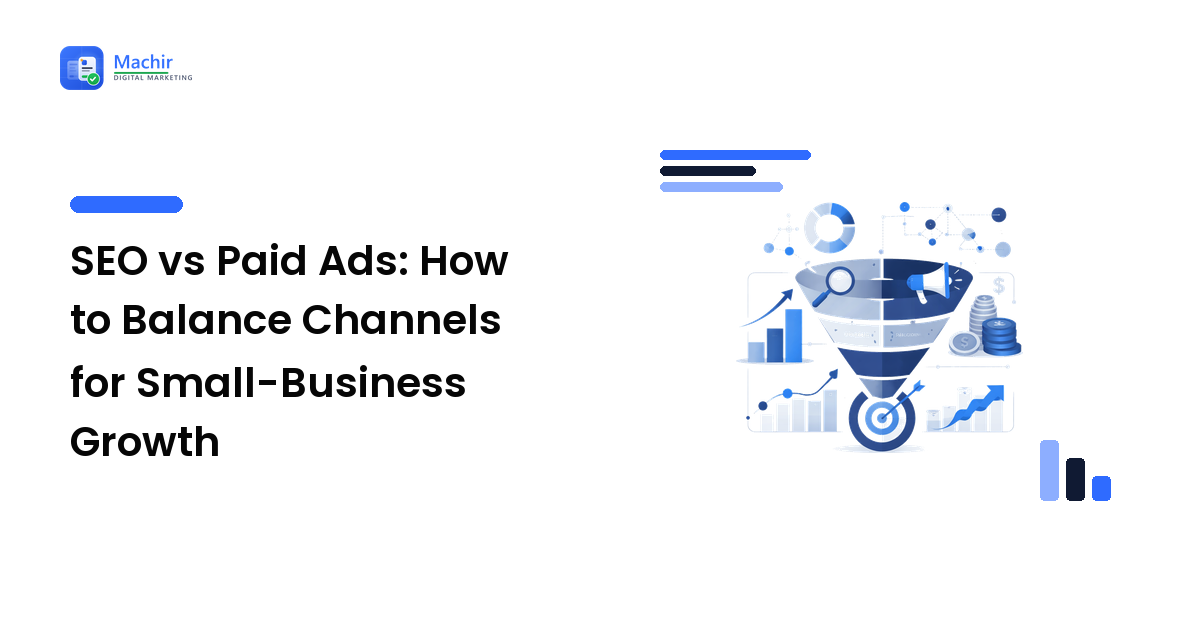
Most small businesses frame it as a choice: SEO or paid ads. That is the mistake. Organic and paid do different jobs on different timelines, so the useful question is not which one to pick but how to weight them for where your business is now — and how that weight should shift as you grow.
Here is a framework: what each channel actually buys, the questions that set the ratio, how the balance moves by stage, and whether to run the mix yourself or hire it out.
What each channel actually buys
The two channels do fundamentally different things:
- Paid ads rent attention. Turn them on and you get clicks today; turn them off and traffic stops the same afternoon. Paid is fast, measurable, and controllable — and it resets every billing cycle. You are buying speed and certainty, over and over.
- SEO and content build an asset. A page that ranks earns visits month after month with no per-click cost, but it is slow to start — several months to meaningful return is normal. You are buying compounding and a lower long-run cost, on credit.
The trade-off is time versus durability. Neither is "better"; they cover different gaps, which is why the answer is usually a mix.
The questions that set your ratio
Before you split a dollar, answer these — the right ratio is the one your situation justifies, not a number you read online.
- How fast do you need revenue, and what are your margins? Short runway pushes you toward paid, which produces signal now — but thin margins are punished by its per-click cost, while healthy ones absorb it as organic builds underneath.
- Is there winnable search demand? If people already search for what you sell, SEO has something to capture — unless incumbents own those rankings, in which case organic is a long siege and paid is the faster door in. If you are creating a category buyers do not know to look for yet, paid and social may be the only way to reach them.
- Do you have time or skill to make content? SEO is cheap in dollars and expensive in hours. With no time and no writer, the "free" channel is not free — just unpaid.
How the balance shifts as you grow
The right split is not fixed — it moves with your stage.
- Early: lean paid. You need revenue now and are still learning which offers convert; paid hands you that data in days. Start one or two SEO pages in parallel so the compounding clock begins — just do not expect them to carry the business yet.
- Growth: build the organic base while paid covers the gaps. Every page that ranks lowers your blended acquisition cost, so keep investing in the asset while paid reaches the searches organic cannot yet.
- Mature: let SEO carry the baseline, use paid to scale peaks. A library of ranking pages becomes your cheapest, steadiest traffic; paid becomes a dial you turn up for launches, seasons, and new markets.
As a rule of thumb, the more established your search footprint, the more each new dollar should defend and extend it — but only your own numbers set the real split.
Run it in-house, or hire it out?
Once the mix is set, the next decision is who runs it. In-house works when you are on one channel, have the hours and skill, and want tight control. Outsource when you are coordinating several channels, lack the throughput or expertise, or your hours are worth more on the business than on keyword research.
There is a catch specific to this framework: SEO and paid are meant to inform each other. Paid data shows which keywords are worth ranking for; organic wins let you redirect ad spend. Hand the two to disconnected vendors and that feedback loop is the first thing you lose. That is the reasoned case for a full-service partner over stitching specialists together — one team can keep the channels talking. SEOeLinks, for instance, is a full-service SEO and digital-marketing agency covering technical, local, and e-commerce SEO alongside content, link building, PPC, and web design — single-roof breadth that suits a business whose plan depends on organic and paid pulling together. The point is not any one firm; it is to match the operating model to your mix. If you would rather compare options first, our guide on how to choose a digital marketing agency covers the questions to ask and the red flags to avoid.
Measure so the balance stays honest
A ratio you never revisit is just a guess that got old. Judge each channel by cost per customer and payback time, not clicks or rankings — a keyword that ranks but never converts is a vanity win. Watch your blended acquisition cost over quarters; if organic is working, it should fall as ranking pages accumulate. Then reallocate quarterly, moving money toward whatever returns best.
FAQ
Should I do SEO or paid ads first?
If you need revenue and demand signal now, start with paid — it works within days. But begin a little SEO in parallel; it takes months to mature, so the sooner you start, the sooner it compounds. For most small businesses the honest answer is "both, weighted toward paid early."
How should I split my budget between SEO and paid?
There is no universal percentage. Weight toward paid when you need speed, are validating an offer, or face entrenched competition; shift toward SEO as ranking pages lower your blended cost. Let cost per acquisition by channel decide, and revisit quarterly.
Is it worth outsourcing to an agency, or should I keep it in-house?
Keep it in-house if you run one channel and have the time and skill — it is cheaper and keeps control close. Outsource when you are coordinating several channels or lack the hours or expertise. Whoever you hire, make sure they report on cost per lead and let you keep ownership of your accounts and data.
Bring it together
SEO versus paid was never the real question. The work is setting a ratio that fits your stage, cash, and margins, then tuning it as your organic base grows, so the two channels stop competing for budget and start compounding — paid buying speed today, SEO buying a base that keeps paying tomorrow.
If the mix is more than you want to run alone, evaluate a full-service partner that can keep SEO and paid coordinated under one roof — SEOeLinks is one option to weigh against your shortlist. Start small, measure by cost per customer, and expand only what earns its place.