Most small businesses do not fail at marketing because they picked the wrong channel. They fail because they run each channel in isolation — an SEO effort here, a social account there, an ad campaign somewhere else — and none of them know the others exist. The result is a marketing budget that looks busy and produces very little, because every channel is starting the customer relationship from scratch instead of building on what the last one did.
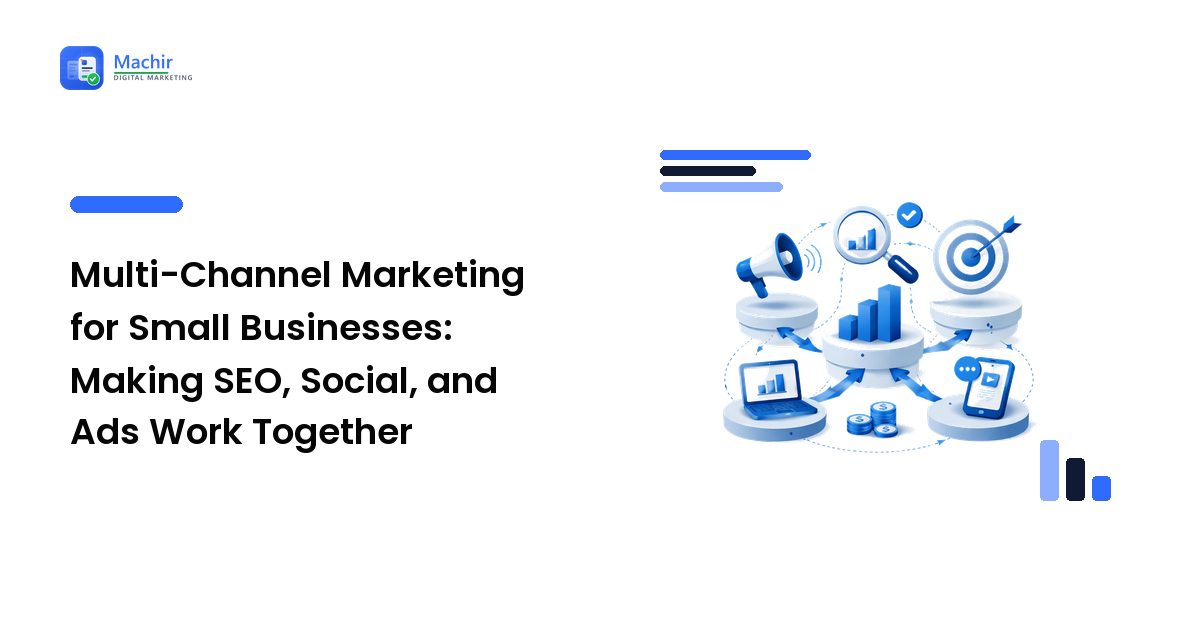
Multi-channel marketing is the fix, but it is widely misunderstood. It does not mean "be on every platform." It means the channels you do run pass work to each other, so a stranger who finds you on Google is warmed up by your social presence and closed by a retargeting ad — one continuous path instead of three dead ends. This guide is about building that path on a small-business budget.
Why silos quietly waste money
Picture a typical small operation. The owner writes the occasional blog post for SEO, posts to Instagram when there's time, and boosts a post now and then. Each of those can work. But run separately, they leak value at every seam:
- The blog post ranks and earns a visitor — who leaves and is never followed up, because nothing captures them.
- The social account builds a small audience — that never gets pointed at anything worth buying.
- The boosted post reaches cold strangers — who have no reason yet to trust the business, so they scroll past.
Each channel is doing a third of a job and finishing none. The money isn't wasted on the wrong channels; it's wasted in the gaps between them.
The one idea that ties channels together
Coordination gets simpler once you stop thinking in platforms and start thinking in stages. Every customer moves through roughly three:
- Discovery — they find out you exist. SEO, social reach, and awareness ads live here.
- Consideration — they weigh whether you're worth it. Content, email, reviews, and your website do this work.
- Conversion — they act. Retargeting ads, landing pages, and follow-up close the loop.
A channel is only "working" if it hands the customer to the next stage. SEO that earns a visit but captures no email has no handoff. An ad that sends traffic to a homepage instead of a matched landing page drops the baton. Map your channels to these three stages and the gaps become obvious — usually you have plenty of discovery and almost nothing carrying people to conversion. Our guide to marketing channels breaks down which channels suit which stage.
A practical way to connect three channels
You don't need a big stack. Three well-connected channels beat seven disconnected ones. Here's a coordination most small businesses can actually run:
- SEO feeds the top. Publish content that answers what your customers search for. This is your steady, compounding source of new discovery — it keeps working after you stop paying.
- Email (or a simple list) catches the middle. Every SEO visit and social follower should have a reason to give you an email — a checklist, a discount, an update list. Now discovery converts into an audience you own, not one a platform rents you.
- Retargeting ads close the bottom. A small retargeting budget shown only to people who already visited or subscribed is the cheapest ad you'll ever run, because it talks to warm people instead of strangers.
Notice the flow: SEO earns the visit, the list captures it, the ad closes it. The same dollar of attention gets used three times instead of once. Add social as the connective glue — it keeps you visible between the discovery and the purchase — and you have an integrated system on a modest budget. The mechanics of stitching these together sit inside your broader small-business marketing strategy.
The real constraint: it's a lot to run at once
Here's the honest problem. Coordinating SEO, content, email, social, and paid ads so they actually feed each other is not hard to understand — it's hard to sustain. Each channel is a job. Doing all of them well, every week, on top of running the business, is more than one time-poor owner can hold. Most small teams can run one channel properly, limp along on a second, and drop the rest. That's exactly how the silos form.
At that point you have three realistic options: narrow down to the one or two channels you can genuinely maintain, hire in-house (expensive and slow), or hand the coordination to a team that runs multiple channels as a single system. That last route is where a full-service agency earns its place — not because outsourcing is magic, but because coordination across channels is precisely the thing a solo owner has no hours for.
The fit matters more than the logo. What you want is a team that runs SEO, content, social, paid ads, and web under one roof, so the channels are planned together rather than bolted on. A shop like AdBerry, a digital marketing agency that offers SEO, social media, paid advertising, content, and web development as one coordinated service, can suit a small business precisely because the handoffs between channels stay inside one team instead of falling into the gaps between separate freelancers. Whoever you consider, judge them on whether their channels talk to each other — and hold them to the same measurement discipline you'd apply to your own work.
Measure the handoffs, not just the channels
However you run it, track the connections, not only the channels in isolation. The numbers that tell you a multi-channel system is working are the seam metrics:
- How many SEO and social visitors join your list (discovery → consideration).
- How many subscribers become customers (consideration → conversion).
- What a retargeted visitor costs to convert versus a cold one (the payoff of coordination).
If those seam numbers are healthy, your channels are genuinely feeding each other. If they're near zero while individual channels look "fine," you've confirmed the silo problem — and know exactly where to fix it.
FAQ
How many channels should a small business run?
As many as you can coordinate, which is usually two or three, not seven. A connected pair of channels that hand customers to each other beats a scattered presence on every platform. Add a channel only when the ones you have are running smoothly and you can maintain the new one.
Is multi-channel marketing just for businesses with big budgets?
No. The point is efficiency, not spend — reusing one visitor's attention across discovery, capture, and conversion so a small budget works harder. A tiny retargeting budget aimed at people who already know you often outperforms a large budget spent shouting at strangers.
Is it safe to outsource my marketing to an agency?
It's a normal operational decision, with the usual caution: outsource the execution and coordination, keep ownership of your accounts, data, and strategy. Start with a defined scope, agree on how results are measured before money moves, and judge the work by the seam metrics above rather than by activity reports.
What's the first step if my channels feel disconnected?
Map each channel to discovery, consideration, or conversion, then look for the missing handoff — most small businesses have plenty of discovery and no capture. Add the one connecting piece (usually an email capture) before you add any new channel.
Bring it together
Multi-channel marketing isn't about doing more; it's about making the marketing you already do work as one system instead of three strangers. Map your channels to discovery, consideration, and conversion, fix the missing handoffs, and measure the seams between them. Then be honest about the hours: if coordinating it all is more than you can sustain, narrowing your focus or handing the coordination to one capable team beats running five channels that never speak to each other.