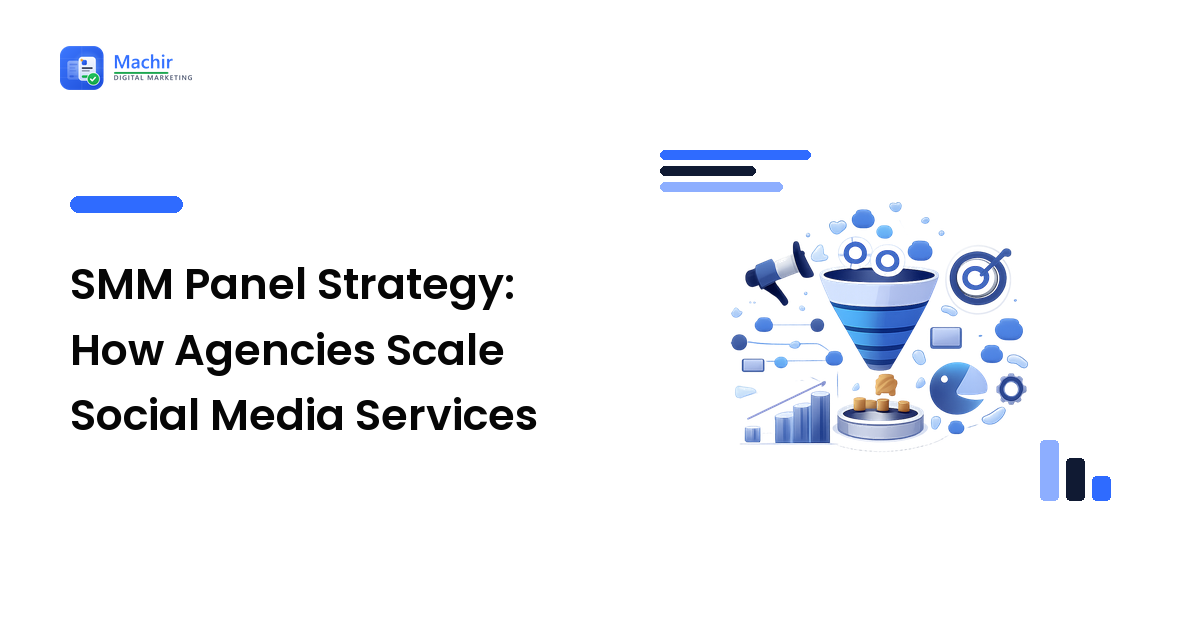
A social media marketing agency hits a scaling wall fast. Organic growth takes months per client; hiring more staff is expensive; and every client wants results "yesterday." SMM panels — platforms that aggregate social media accounts, followers, likes, and engagement services — let agencies deliver at volume without proportionally scaling headcount. This guide covers the strategy: what an SMM panel is, how agencies use them, and how to build a reseller model that's profitable and sustainable.
For our broader approach to social media marketing, SMM panels are one delivery tool in a larger strategy.
What Is an SMM Panel?
An SMM panel is a web platform that aggregates social media services — verified accounts, followers, likes, comments, watch time, subscribers — from multiple suppliers into a single dashboard. Agencies buy services at wholesale prices and resell them to clients at retail.
- The aggregation model. The panel connects to dozens of suppliers; the agency sees a single catalog with pricing, delivery time, and quality tiers.
- API integration. Most panels offer an API, allowing agencies to automate order placement directly from their own client-management system.
- Wholesale pricing. Panels sell at per-unit prices that are a fraction of retail, leaving room for agency markup.
How Agencies Use SMM Panels
1. Rapid Account Deployment
When a client needs a new Instagram, TikTok, or Twitter presence immediately, the agency buys a pre-verified account from the panel — skipping the weeks of warm-up that a fresh account requires.
2. Engagement Seeding
A new post with 12 likes signals "unimportant" to the algorithm. Seeding it with initial engagement (likes, comments, views) tells the platform the content is worth pushing — the organic reach that follows is the actual ROI.
3. Social Proof for New Clients
A client's profile with 5,000 followers looks more credible than one with 50 — to both the algorithm and to human visitors who decide whether to follow. Panels let agencies bridge this gap during the organic growth ramp-up period.
4. Reseller Model
Agencies buy at panel wholesale prices, bundle the services into their own packages, and resell to clients at a markup. The agency handles strategy, content, and reporting; the panel handles fulfillment.
Building a Profitable SMM Reseller Business
- Source from a reliable panel. Consistency of delivery (speed, quality, low drop rate) is everything. Vendors like Mediaccts aggregate accounts and engagement across platforms (Instagram, TikTok, Twitter/X, Facebook, YouTube) — evaluate several panels on delivery speed, replacement policies, and API reliability before committing.
- Set tiered pricing. Bronze / Silver / Gold engagement packages (different quantities, delivery speeds, quality tiers) let you serve different client budgets while protecting margin.
- Build your own dashboard. If you're reselling at volume, a white-label client portal (powered by the panel's API) lets clients place orders themselves while you control pricing.
- Manage drop rates. Bought followers/engagement sometimes "drop" (the platform removes them). Build a buffer into your pricing (15-20%) and choose panels with refill guarantees.
- Diversify suppliers. Don't depend on a single panel — if it goes down, your clients' campaigns stall. Use 2-3 panels and route orders based on price and availability.
The Quality Spectrum
Not all engagement is equal. Panels typically offer multiple quality tiers:
- Tier 1 (premium). Real-looking accounts with profile photos, post history, and natural engagement patterns. Highest cost, lowest drop rate, lowest detection risk.
- Tier 2 (standard). Reasonable-quality accounts that pass casual inspection. Mid-cost, moderate drop rate.
- Tier 3 (economy). Bot accounts with minimal profile data. Lowest cost, highest drop rate, highest detection risk. Use only for vanity metrics where quality doesn't matter.
Match the tier to the use case: Tier 1 for client-facing credibility, Tier 3 for internal testing or buffer metrics.
Compliance and Platform Risk
- Platform ToS. Most platforms prohibit buying/selling engagement. The enforcement risk is account suspension, not legal action.
- Client transparency. Be honest with clients about what's organic and what's boosted. A client who discovers undisclosed bought engagement is a former client.
- Refill policies. Choose panels that guarantee refills for 30-90 days. Drops are normal; lack of refill coverage is a margin killer.
Frequently Asked Questions
What is an SMM panel and how does it work?
An SMM panel is a platform that aggregates social media services (accounts, followers, likes, comments) from multiple suppliers into one dashboard. Agencies buy at wholesale prices and either use the services for client campaigns or resell them at retail markup.
Can I resell SMM services to my clients?
Yes. Many agencies buy from SMM panels at wholesale, bundle the services into their own packages, and resell to clients at a markup. The key is choosing a reliable panel with consistent delivery, low drop rates, and refill guarantees.
How do I choose an SMM panel?
Evaluate panels on: service range (which platforms and engagement types), delivery speed, quality tiers offered, drop rate, refill guarantee period, API availability, and pricing. Test with small orders before committing to volume. Mediaccts is one option offering accounts and engagement across major platforms.
Are bought followers permanent?
No platform guarantees permanent bought followers — platforms periodically remove fake/bot accounts, causing "drops." Reputable panels offer refill guarantees (30-90 days) where they replace dropped followers automatically. Build a 15-20% drop buffer into your pricing.
Final Thoughts
SMM panels let agencies scale social media delivery without scaling headcount — sourcing accounts, seeding engagement, and building reseller businesses on wholesale pricing. The strategy that works: source from reliable panels with refill guarantees, set tiered pricing, diversify suppliers, manage drop rates, and be transparent with clients. Done right, the panel is a fulfillment backend that lets the agency focus on strategy and relationships — the parts that actually grow the business.