If you've spent any time trying to grow a social account, you've seen the promise: thousands of followers, views, or likes for a few dollars. The tool behind most of those offers is an SMM panel — and whether it helps you or hurts you comes down entirely to how you use it. This guide explains what SMM panels actually are, where they genuinely add value, the risks nobody advertises, and the rules for using one without damaging the account you're trying to grow.
The short version: an SMM panel is a legitimate wholesale storefront for social media services. It is neither a magic growth button nor automatically "against the rules" — but treating vanity metrics as a strategy will waste money and can get accounts flagged. Used deliberately, as a small boost around real content, it can help. Used blindly, it backfires.
What an SMM panel actually is
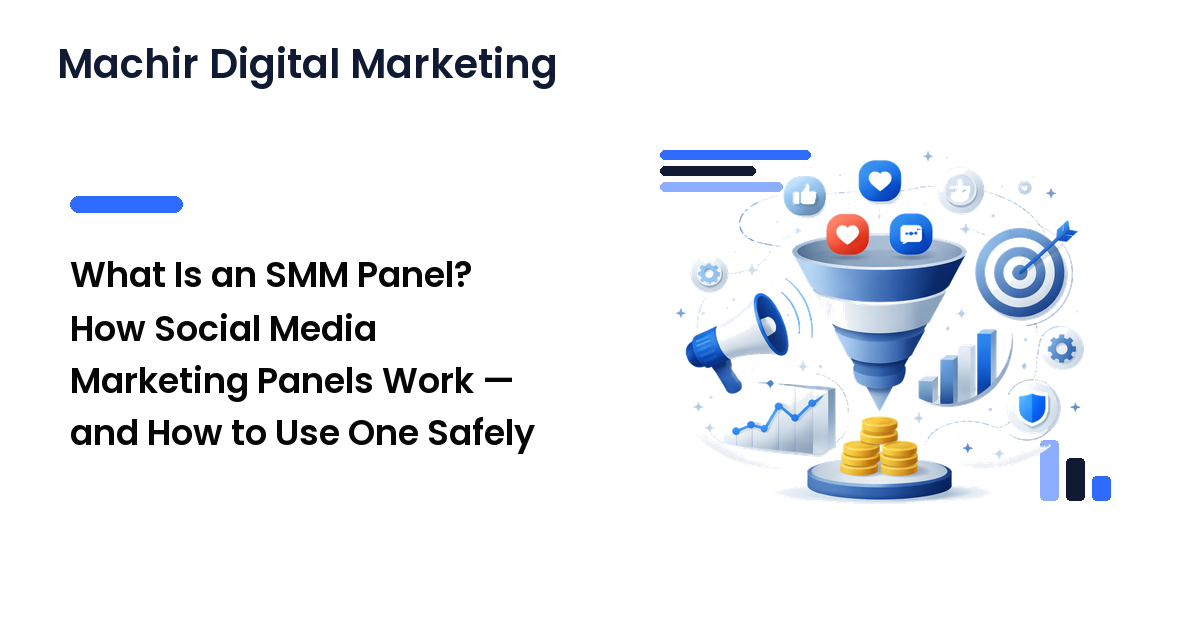
SMM stands for social media marketing, and an SMM panel is a self-service dashboard where you order those services in bulk at reseller prices — followers, likes, views, comments, subscribers, and streams across platforms like Instagram, TikTok, YouTube, and Spotify. Think of it less as "buying fans" and more as a wholesale marketplace: panels aggregate supply from many providers and expose it through one ordering interface and, usually, an API.
Two kinds of people use them:
- End users — a creator or business buying a boost for their own profile.
- Resellers and agencies — people who buy wholesale on a panel and resell to their own clients at a markup, or fold the service into a broader social package.
That reseller layer is why panels exist as a category: they're infrastructure for the SMM industry, not just a checkout for followers.
How SMM panels work
The mechanics are simpler than they look:
- You pick a service — for example "Instagram followers" or "YouTube views" — each with its own price per thousand and quality tier.
- You paste a link to the post or profile and set a quantity.
- The panel routes the order to a provider that fulfills it, and delivery starts within minutes to hours.
- You track status in the dashboard (and via API if you're automating for clients).
Prices are quoted per 1,000 units, and the range is wide because quality varies enormously — from obvious empty bot accounts to more realistic profiles with pictures and activity. The cheapest option is almost never the one you want.
Where SMM panels genuinely help
Used well, a panel solves a few real problems:
- Social proof at zero. A brand-new profile with 12 followers struggles to earn the next 100 — people trust accounts that others already follow. A modest, believable base can lower that first hurdle.
- Kickstarting reach on a specific post. A bump in early views or engagement can help a piece of content clear the threshold where the platform starts showing it to more people.
- Saving time for agencies. If you manage many client accounts, sourcing services wholesale through one panel and API is far more efficient than juggling vendors.
Notice the pattern: every good use is a boost around real work, not a replacement for it.
The risks nobody puts in the ad
Be honest with yourself about the downsides, because they're real:
- Low-quality or dropping counts. Cheap bot followers get purged by the platform, so your 5,000 can become 3,200 next month.
- Engagement math that doesn't add up. 50,000 followers and 20 likes per post is a giant red flag to both the algorithm and any real customer who visits.
- Platform terms. Buying fake engagement violates most platforms' terms of service; over-relying on it risks limits or suspension.
- Vanity over outcomes. Followers are not customers. If a number doesn't move sales, leads, or genuine reach, it's decoration.
How to use an SMM panel safely
If you decide to test one, treat it like any paid channel — carefully and measured:
- Start small and test quality first. Order a tiny quantity to a test post, wait a week, and check whether it drops or looks obviously fake before you spend more.
- Choose gradual, realistic delivery over instant dumps of 10,000 — sudden spikes look unnatural.
- Keep the ratios believable. Don't buy followers without any engagement, or views with zero likes; lopsided numbers are the giveaway.
- Never make it the strategy. Pair any boost with a real content calendar and genuine engagement — the boost only earns its keep if real content is there to catch the attention it borrows.
- Use a reputable panel. Quality, refill guarantees, and support vary wildly. A platform with broad coverage across Instagram, TikTok, YouTube, and Spotify — like FIRE SMM — lets you source and compare services in one place and test small before scaling, which is exactly the disciplined approach that keeps this tactic from backfiring.
FAQ
Are SMM panels legal? Buying social services isn't illegal, but inflating engagement usually breaks the platform's terms of service. The practical risk is to your account, not the law — so use it sparingly and realistically.
Will bought followers get my account banned? A cautious, gradual boost rarely triggers action on its own. Large, sudden, low-quality dumps are what draw scrutiny and get purged. Quality and pacing matter more than quantity.
Do bought followers turn into customers? Not directly — they're social proof, not buyers. Their only value is making real people more comfortable following or trusting you, which is why they must sit on top of real content.
How do I judge a good SMM panel? Look for realistic-looking delivery, refill or refund guarantees, responsive support, and broad platform coverage. Test with a small order before trusting it with a client's account.
The takeaway
An SMM panel is a wholesale tool for social media services — useful as a small, well-paced boost around genuine content, and a money pit (or a liability) when treated as a growth strategy. Start small, demand quality, keep the numbers believable, and always anchor it to real work. If you want to test the waters, evaluate a reputable panel like FIRE SMM with a small order first, measure what actually moves, then decide whether to scale.